

























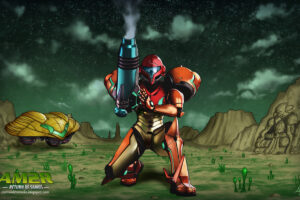




Metroid Prime 4: Beyond Developers Talk Design Decisions, Timeline Placement in New Interview
If you’ve been yearning to learn more about the development of Metroid Prime 4: Beyond, you’re in luck! The latest issue of Japanese publication Famitsu features quite a beefy interview with the game’s developers at Nintendo, covering a whole range of topics from the team’s earliest design decisions, to their open-world approach, to the title’s placement in the overall Metroid timeline.
The interview, as partially translated by Nintendo Everything, begins with the developers (left unnamed by Famitsu) detailing how the project started with a “request from Nintendo of America… to make a new mainline game in the numbered Metroid Prime series:”
We thought about how to make a game that kept the ‘Prime’-ness while also delivering a new experience. At the same time, we made the relationship between Samus and Sylux the main thread for the story, something we had wanted to do at some time.
When asked about challenges faced during development, the interviewees discuss how progress was restarted at Retro Studios:
…At that time, Retro did not have the structure to make a Metroid Prime game, so first we had to begin by making that structure. Furthermore, we outsourced some of the background model and movie creation to external companies – particularly the background data required a lot of external support – so first we had to start by selecting those companies, and then following that, further management was necessary. The progress management staff were very helpful while considering both the schedule and quality. I have a lot of gratitude for them. I also have great appreciation for everyone at the studio who helped make the data.
As for things we paid attention to, I suppose it was making sure that new staff understood our design plan. This wasn’t just making a game, it was making an experience for the player, particularly it took time for everyone to understand the feel of ‘ma’ of Metroid Prime.
In the end I think they understand it, as well as the Japanese concept of ‘ma’.
* Note: this refers to the idea of the space between, for example between objects, time, sound, people etc. By appreciating that gap, people can better understand the passing of time, sense of beauty, etc.
The respondents also reveal that they “outsourced some of the background model and movie creation to external companies” when addressing this question. If you’re curious about just how many studios worked on Metroid Prime 4: Beyond, check out this recent analysis of the game’s credits.

Nintendo’s developers are then asked about changes made to the Metroid Prime formula to “reflect the times,” prompting an interesting allusion to the Legend of Zelda franchise:
At the start of the project, perhaps due to the influence of The Legend of Zelda: Breath of the Wild, we saw a lot of comments on the internet saying ‘we want to play an open-world Metroid’. However, Metroid’s core element of ‘increasing the amount of explorable areas by unlocking powers’ is not very compatible with the ‘freedom to go anywhere from the beginning’ of open worlds. Thus we thought to design a limited area that could be freely explored, and have that be a hub that could connect to other areas. Then we thought that if one could move around on the bike in a satisfying way in that area, it could be a segment that mitigates the tension from exploration, and paces the whole game.
In the end, the game took much longer than expected to finish, and we realized that players’ impressions toward open-world games had changed. That being said, development had already been reset once before (when we started again from scratch with Retro Studios) so backtracking development again was out of the question, and we resolved to move forward with our original vision. During this time, shooting games and action games went through evolutions, with an increase in game speed in particular, but taking in those changes would have made it difficult to construct the tempo of an adventure game, so we actively chose to not take them into account. Therefore, I think this game is pretty much divorced from the changing of times.
Further into the interview, the team shares about how the expansion of Sol Valley directly inspired the creation of the Vi-O-La vehicle.
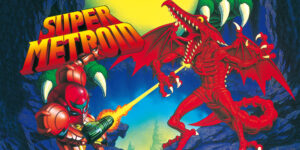
Most interestingly, the interview touches on Beyond’s place in the greater Metroid timeline. According to the developers, Prime 4 is “set between Super Metroid and Metroid Fusion:”
That being said, in this game Samus is sent to another dimension, beyond space and time, so you don’t need to worry about the timeline. This was a deliberate choice, giving us freedom to create a unique setting for Metroid Prime without impacting the 2D Metroid series.
The above passage was translated by Shinesparkers.
Beyond these responses, the interview covers a handful of other interesting topics, including Prime 4’s psychic abilities, its cast of Galactic Federation companion characters, and its dreaded antagonist Sylux. You can read a full translation of the interview right here.
And if you want to learn even more about Metroid Prime 4: Beyond’s long development period, check out our own retrospective right here.
What was your biggest takeaway from this Famitsu interview? What do you think of Metroid Prime 4’s official timeline placement? Let us know in the comments below or over on our Discord!
Source: Famitsu (via Nintendo Everything (1, 2, 3), TheDinoman)
Playing Metroid Prime 4: Beyond? Check out our guides and latest podcast episodes.
Editor’s Note: This article was edited to include a citation for Shinesparker’s English translation of the interview discussed.

Rod Lloyd is a reserve copy editor and writer for Omega Metroid, helping to oversee the news and feature content for the site. He also serves as the Editor-In-Chief at Zelda Dungeon, which covers the Legend of Zelda series. Follow him on Bluesky!


You May Also Like

RANDOM: Metroid Prime 4: Beyond Has Entered the “Milk-Radius”
Episode 20: Metroid Going “Casual” & More Metroid Questions Answered!